Every founder asks the same question before they ask anything else: what will this cost? It is a fair question and a hard one to answer honestly, because "an MVP" can mean a four-week landing page with a waitlist or a six-month regulated fintech platform. The number that matters is not the average quoted by an industry survey — it is the number attached to your specific feature set, your specific compliance requirements, and your specific launch deadline. This guide breaks down what MVP development actually costs in 2026, what each budget tier buys you in practice, where founders reliably waste money, and how to walk into a conversation with a development partner already knowing which questions determine the price.
The Short Answer: MVP Price Ranges in 2026
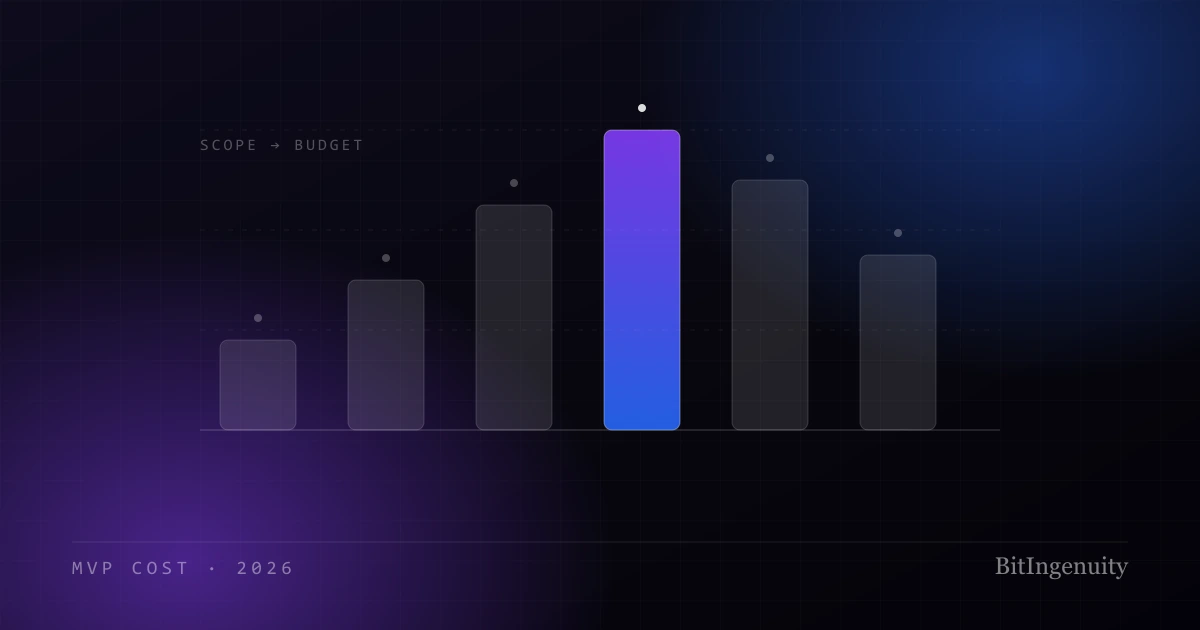
Most startup MVPs built by a professional development partner land between $18,000 and $80,000. Below $18,000 you are typically buying a prototype, a no-code assembly, or a single well-executed feature rather than a product. Between $18,000 and $35,000 you get a focused MVP: one core workflow, authentication, a clean responsive interface, payments if needed, and a production deployment. Between $35,000 and $60,000 you get a multi-role product — for example an admin dashboard plus a customer portal — with integrations into a CRM or accounting system and a real data model designed to grow. Between $60,000 and $80,000 you are into AI-enabled products, marketplaces with two-sided flows, or MVPs entering regulated industries where security review and audit trails are non-negotiable. Above that, you are no longer building an MVP; you are building version one of a company.
What Actually Drives the Price (And What Does Not)
Price is driven by four things: the number of distinct user roles, the number of external systems you integrate with, the amount of custom design required, and the regulatory surface area. Each new user role roughly multiplies the permission logic, the screens, and the testing surface. Each external integration — Stripe, Salesforce, Xero, Twilio, an industry-specific API — adds discovery, error handling, and edge-case work that rarely appears in the original estimate. Custom design costs more than a component library, but it is often what makes an early product credible to investors and users. Regulatory requirements such as HIPAA, SOC 2 readiness, or GDPR data residency add real engineering work, not just paperwork. What does not meaningfully drive price: the specific framework chosen, the visual polish of the marketing site, or the number of "nice to have" features, because those should not be in an MVP at all.
Where Founders Waste the Most Money
The single most expensive mistake in MVP development is building features nobody asked for. In practice this happens when a founder briefs an agency on the full product vision, and the agency quotes and builds the full product vision because that is what was requested. The second most expensive mistake is choosing a partner on hourly rate alone. A $25/hour team that takes 900 hours costs more than a $85/hour team that takes 240 hours, and the cheaper build usually needs rewriting within a year. The third is skipping discovery: without a mapped user flow and a defined data model, developers make architectural guesses that get expensive to unwind. The fourth is treating design as decoration to be added at the end — retrofitting a coherent interface onto finished screens costs several times what designing it upfront would have. A good partner will actively push back on all four before quoting.
Fixed Price vs Time and Materials — Which Protects You
Fixed-price contracts feel safer to founders and often are, provided the scope is genuinely locked. The risk is that fixed price forces both sides to argue about whether a change is "in scope," which slows delivery and damages the relationship. Time and materials gives flexibility but shifts budget risk onto you. The pragmatic middle ground most experienced MVP partners use is a fixed-price discovery phase followed by capped sprints: a defined budget per two-week sprint, a demo at the end of each, and the right to stop after any sprint. This gives you a predictable burn rate, visible progress, and a genuine exit if the partnership is not working — which is far more protection than a fixed-price contract that only pays out at the end.
Cost Breakdown by Phase: Where the Money Goes
On a typical $40,000 MVP, the money distributes roughly as follows. Discovery and product definition: 8–12%, covering workflow mapping, feature prioritisation, and technical architecture. Product design: 15–20%, covering wireframes, the interface system, and clickable prototypes reviewed before code is written. Front-end engineering: 25–30%, building the interfaces, states, and responsive behaviour. Back-end engineering: 25–30%, covering the data model, APIs, authentication, permissions, and integrations. QA and stabilisation: 8–12%. Deployment, monitoring, and handover: 5–8%. If a quote allocates nothing to discovery or design, that work has not disappeared — it has been pushed into engineering, where it costs more and produces worse outcomes.
How AI Features Change the Budget
Adding AI to an MVP costs less than founders expect on the build side and more than they expect on the operational side. Integrating an LLM for summarisation, classification, or natural-language search is now a well-trodden path — typically two to four weeks of work including prompt design, evaluation, and fallback handling. Retrieval-augmented generation over your own documents adds ingestion, chunking, and a vector store, pushing that toward four to seven weeks. What surprises founders is inference cost at scale, the engineering needed to make outputs reliable enough to show users, and the evaluation harness required to know whether a prompt change made things better or worse. Budget for the evaluation work explicitly. An AI feature that produces confidently wrong answers damages an early product more than not having the feature at all.
Offshore, Nearshore, or Local: The Real Cost Comparison
Hourly rates vary enormously by geography — roughly $120–$220 in the US and Australia, $70–$120 in Western Europe, and $25–$60 across much of Asia and Eastern Europe. But hourly rate is a poor predictor of total cost. What actually determines your bill is how many hours the team needs, and that is driven by seniority, domain familiarity, and communication overhead. A distributed senior team with strong written communication and meaningful timezone overlap frequently delivers a better MVP for less total spend than a large local team or a cheap offshore team requiring constant supervision. The question to ask is not "where are you based" but "who exactly will write my code, how many years have they shipped production products, and how many hours of overlap will I have with them each day."
What to Ask Before Accepting Any Quote
Before signing, get written answers to six questions. What exactly is included in this number, feature by feature? What is explicitly excluded? Who owns the code and the repository from day one — the answer must be you, in your own GitHub organisation. What happens if we discover mid-build that a feature is harder than estimated? What is the post-launch arrangement: is there a warranty period for defects, and what does ongoing support cost? Who are the actual named individuals doing the work, and will they change? A partner who answers all six clearly and in writing is telling you something more valuable than their price: that they have done this enough times to know where projects go wrong.
Budgeting for What Comes After Launch
The build cost is not the whole cost, and founders who plan only for the build run out of money at exactly the wrong moment. Reserve 20–30% of your build budget for the first three months post-launch. Real users find edge cases no test suite anticipated. Analytics reveal that the feature you were sure about goes unused while a minor one drives retention. Infrastructure, third-party APIs, and AI inference generate a recurring bill that scales with usage. Most importantly, the whole point of shipping an MVP is to learn, and learning is worthless if you have no budget left to act on it. A partner who insists on discussing the post-launch phase before you sign is protecting your outcome, not upselling you.
Conclusion
MVP pricing only looks opaque from the outside. Once you understand that cost is a function of user roles, integrations, design depth, and compliance burden, you can scope deliberately instead of hoping for a low quote. Decide what single hypothesis your MVP must test, cut everything that does not test it, and hold budget in reserve for what you learn after launch. BitIngenuity scopes and builds startup MVPs and AI-enabled products on a modern Next.js and TypeScript stack — with fixed-price discovery, capped sprints, code you own from day one, and honest pushback when a feature does not belong in version one. Tell us what you are trying to prove and we will tell you what it costs to prove it.