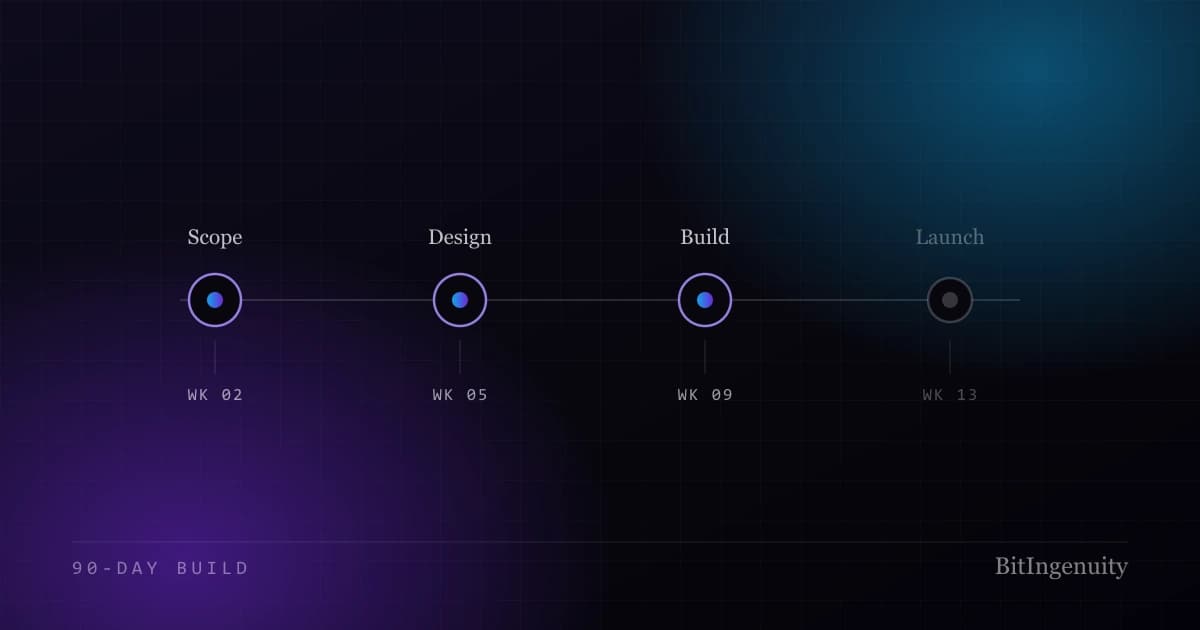
Ninety days is not an arbitrary marketing number. It is roughly the longest a small team can hold focus on a single objective before priorities drift, and roughly the shortest window in which a real product — not a prototype — can be designed, built, tested, and put in front of paying users. Most MVPs that miss this window do not miss it because engineering was slow. They miss it because scope was never fixed, decisions took days to make, or design and development ran sequentially instead of overlapping. This roadmap lays out what a well-run 90-day MVP build looks like week by week, what the founder is responsible for at each stage, and where timelines genuinely break.
Before Week One: The Three Decisions That Set the Clock
Nothing should start until three things are settled. First, the hypothesis: state in one sentence what you believe about your users that this product will prove or disprove. "Independent dental practices will pay $200 a month to automate recall reminders" is a hypothesis. "A platform for dental practices" is not. Second, the single success metric: the one number that tells you at day 90 whether the hypothesis held. Third, the decision-maker: exactly one person with the authority to approve scope, design, and priority calls without a committee. Projects with two decision-makers do not take twice as long, they take three times as long, because every ambiguity becomes a negotiation. Founders who arrive with these three settled routinely finish four to six weeks ahead of those who do not.
Weeks 1–2: Discovery and Scope Lock
Discovery converts an idea into a buildable specification. The team maps every user role and the end-to-end flow each one takes through the product, identifies the data entities and how they relate, lists every external system that must be integrated, and surfaces the constraints — compliance, existing tools, migration of legacy data — that will shape the architecture. The output is a prioritised feature list split into "required to test the hypothesis" and "everything else," a technical architecture outline, and a firm estimate. This is also where the hardest conversation happens: cutting. A typical founder list of 25 features leaves discovery as 9. Scope lock at the end of week two is the mechanism that makes the remaining 11 weeks predictable, and skipping it is the most common single cause of a 90-day build becoming a nine-month one.
Weeks 3–5: Design and Foundations in Parallel
Design and engineering should overlap, not queue. While designers produce the interface — wireframes first, then a clickable prototype of the primary flow — engineers build the parts of the system that do not depend on final visuals: repository and environments, CI pipeline, database schema, authentication, permission model, and the API surface. By the end of week five you should be able to click through a realistic prototype of the core journey and give feedback while changes still cost minutes rather than days. Reviewing a prototype is the highest-value hour a founder spends in the entire project. A misunderstanding caught here costs a design revision; the same misunderstanding caught in week ten costs a sprint.
Weeks 6–10: Build in Two-Week Sprints
The build phase runs as two-week sprints, each ending in a working demo deployed to a staging environment you can use yourself. Sprints are sequenced so the riskiest work comes first: integrations with third-party systems, anything involving AI or non-deterministic behaviour, and complex permission logic. The predictable work — settings screens, admin tables, notification preferences — is deliberately scheduled last, because it is the safest thing to cut if a sprint runs long. Every sprint should ship something demonstrable end to end rather than a horizontal layer, so progress is visible in the product rather than only in a task tracker. Your job during this phase is narrow and non-negotiable: attend the demo, give clear feedback within 48 hours, and make decisions when asked.
Weeks 11–12: Hardening, Testing, and Launch Readiness
The last two weeks are not for new features, and protecting that rule is what makes a launch date real. This phase covers end-to-end testing across roles and devices, error and empty-state handling, performance work on the slowest pages, security review of authentication and access control, and analytics instrumentation so that at day 90 you can actually measure your success metric. Operational readiness matters as much as the code: production environment configured, monitoring and error alerting wired up, backups verified by an actual restore, a documented rollback procedure, and support channels ready. Run a beta with five to ten real users before public launch. They will find in two days what the team would not find in two weeks.
What Founders Are Responsible For
The fastest builds correlate less with engineering speed than with founder responsiveness. Your responsibilities are concrete: answer product questions within one business day, since a blocked engineer is expensive idle capacity. Provide content — copy, legal pages, pricing, seed data — by the dates in the plan, because missing content blocks whole screens from being finished. Set up third-party accounts in your own name early, particularly payment providers, which often require identity verification that takes a week. Attend every sprint demo. Resist mid-sprint feature requests by writing them into a version-two list instead. And decide, rather than deferring: an imperfect decision made today almost always beats a perfect one made next Friday.
Where 90-Day Builds Actually Go Wrong
Five failure modes account for nearly every overrun. Scope creep dressed as small requests — each feels minor, and collectively they add a month. Slow feedback loops, where a three-day turnaround on a design review silently costs a week of sequenced work. Third-party dependencies discovered late: an API with an approval process, a payment provider requiring compliance review, a client's legacy system with no documentation. Founder unavailability, usually because fundraising collides with the build. And treating launch as a finish line rather than a transition, so no budget or attention remains for the first month of real usage. The remedy for all five is the same: name them at kickoff, assign owners, and review them at every sprint demo instead of discovering them at week ten.
When 90 Days Is Not Realistic
Not every product fits the window, and a partner who promises otherwise is selling rather than planning. Regulated products — healthcare with HIPAA obligations, fintech with KYC and licensing, anything requiring SOC 2 before a first enterprise customer — carry compliance work that cannot be compressed. Two-sided marketplaces need both sides functional before either is testable, which effectively doubles the core scope. Hardware or IoT integration introduces physical dependencies that ignore software schedules. Products whose entire value rests on novel AI research, as opposed to applied AI integration, need an experimentation phase with genuinely unpredictable duration. In these cases the right move is not to compress the build but to narrow the hypothesis: ship a smaller slice in 90 days that still tests something real.
Day 91: What Happens After Launch
Launch day is the beginning of the part that determines whether the previous 90 days were worthwhile. The first month post-launch is for watching real behaviour against your success metric, fixing the defects real usage exposes, and talking to users who signed up and did not return. Expect the data to contradict at least one confident assumption — that is the return on the whole exercise. Plan a short stabilisation sprint in week one after launch, then a decision point at roughly day 120: double down, pivot the core flow, or stop. Keep 20–30% of your build budget for exactly this. An MVP that ships with an empty bank account cannot act on anything it learns, which makes the learning worthless.
Conclusion
A 90-day MVP is achievable for the large majority of software products, but only under conditions most projects never establish: one sharp hypothesis, one decision-maker, a scope locked at week two, design and engineering running in parallel, and a founder who responds within a day. The constraint is not engineering capacity — it is clarity and decision speed. BitIngenuity runs exactly this cadence for startup MVPs and AI-enabled products: two weeks of fixed-price discovery, capped two-week sprints with working demos, and a launch-readiness phase that is protected rather than negotiable. If you have a hypothesis worth testing and 90 days to test it, tell us what you are trying to prove.